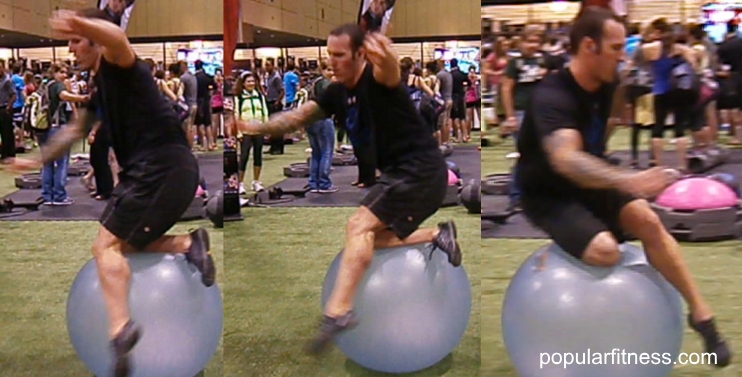
Ab exercises using gym balls are primarily used to achieve and enhance an individual's functional movement, which prepares our bodies for the physical challenges of our lives; such as lifting correctly, playing with our children, working and recreational activities. Balance is the key, since the challenge of maintaining perfect posture on the ball is fun, exhilarating and absolutely effective in building torso and trunk strength and stability.
80% of our population will experience some kind of back pain in their life. Now, using exercise balls, the bad posture, poor body mechanics and inflexibility can be replaced with proper conditioning and balancing of trunk musculature. This minimizes spinal stress by strengthening and stretching both anterior and posterior muscle groups.
Supine Trunk Curl
- Primary Muscles Worked: Rectus abdominus, internal and external obliques
- Primary Stabilizers: Neck, hips, legs
- Joint Action(s): Lumbar spinal flexion
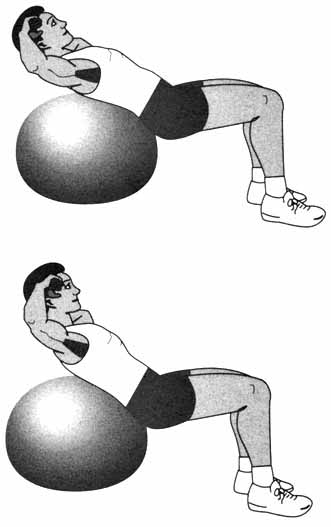
- Starting Position: Supine incline position with arms crossed over the chest or fists placed at your temples.
- Execution of Exercise: Slowly curl your trunk, letting your shoulders and upper back lift off the ball. Return slowly to starting position and neutral posture. If your neck becomes fatigued, place one or both hands behind the head for support.
- Technique and Cueing Tips: Curl your trunk by pulling the bottom of your ribcage down toward your hips. Avoid pulling on the head or neck. Return to neutral posture between each repetition.
INTENSITY VARIATIONS:
Level II: Begin in the supine incline position as above. Walk your feet backward, letting the ball roll down your back until it is centered under the lumbar spine. Your trunk is now more parallel to the floor (supine with lumbar support - base position). Either place your hands behind your head, or place your fists at your temples for more neck stabilization. Curl your trunk as described in Level I, then slowly return to starting position. This exercise requires more abdominal strength, balance and postural stabilization than the Level I variations.
Recommended Reading:
The Great Body Ball Handbook
This comprehensive book covers a series of ball exercises and stretches to work the whole body, including abdominals. Each exercise has a start and finish photo, with easy to follow step-by-step instructions.
The Great Body Ball Handbook also discusses proper ball inflation, the proper form and posture when performing the exercises, as well as pointers on stretching, aerobic training, and safety.
Balance on the Ball - Key benefits of training on the Ball:
- Muscle tone/definition
- Core strength
- Flexibility
- Posture
- Balance
- Coordination
- Body awareness
