Book Excerpts and Book Review
by Mark Verstegen and Pete Williams
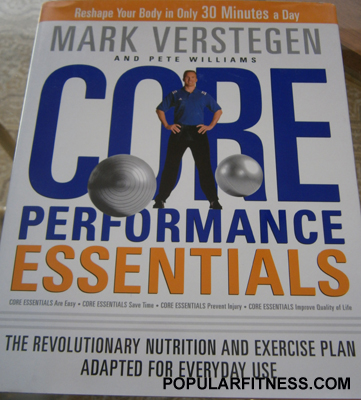
Mark Verstegen presents an innovative exercise and nutrition plan in his book Core Performance Essentials. His approach to fitness focuses on core body movements to help you to improve your strength, flexibility and overall health. It's ideal for beginners as well as athletes who are looking for new ways to improve their performance.
What I really like about this book and his approach to exercise and overall health is that he provides reasons for using core body movements and proper posture not only while you are exercising, but in your daily life. He presents photo illustrations of all his exercises with detailed instructions on performing them and what to look out for while performing each exercise. Best of all, these exercises can be done in 30 minutes a day with very limited equipment.
Whether you use his exercise and nutrition plan in it's entirety or you are looking for a new approach to fitness or ways to improve yourself, this book contains a lot of interesting and valuable information presented in a clear and concise manner and is definitely worth reading.
I have included three fairly lengthy book excerpts below on:
- Pillar Strength
- Shoulder Stability
- Core Stability
PILLAR STRENGTH
Pillar strength is the foundation of all movement. It consists of hip, core, and shoulder stability. (if you're having a hard time getting your head around this concept, it might help to picture your body as a mannequin with no limbs.) Those three areas give us a center axis from which to move. If you think of the body as a wheel, the pillar is the hub, and the limbs are spokes.
We want to have the hub perfectly aligned so we can draw energy from it and effectively transfer energy throughout the body. It's impossible to move the limbs efficiently and forcefully if they're not attached to something solid and stable.
There's a reason why parents are forever telling kids to sit up straight. Without pillar strength, without what, I call "perfect posture," you will significantly increase the potential for injury in a chain that starts with your lower back, descends all the way to the knees and ankles, and rises up to your neck, shoulders, and elbows.
The reason we train body movements instead of parts is because everything about the body's engineering is connected. What happens to the big toe affects the knees, the hips, and ultimately the shoulders. The muscular system is both complex and simple, a series of muscular and fascial bands that work seamlessly to produce efficient movement. Many workout programs do more damage than good by producing muscle imbalances and inefficient movement patterns that sabotage this highly coordinated operating system that we're born with.
Remember the way that movement evolves in infants. They move on their backs until one day this action allows them to roll over, initiating the hip crossover movement. Soon they progress to crawling, standing, and, finally, walking. With each step, they realize how to stabilize their bodies.
Aging reverses that process. Many people lose the ability to squat and maintain their balance, creating poor posture. Eventually, they lose the ability to stand, surrendering the core fundamental movement patterns they developed as toddlers. But instead of conceding that devolution as an unavoidable part of aging, why not look at getting older as a process of taking these movements to new levels? In this program, you're going to take your body to the highest levels of performance and movement capabilities by challenging yourself to increase flexibility and stability. We'll help you do this by adding resistance or increasing the balance demands. This will put you farther and farther away from the regression of aging.
Look, I'm not here to bash bodybuilding and tell you not to lift weights. This program includes resistance training because of its undeniable benefits. The Movement Prep and Prehab routines you'll learn are not a cutesy program to ram the concept of functional exercise down your throat. It's more about reprogramming the body to function properly -- as nature intended -- and to continually become stronger. It's possible to become physically stronger every day of our lives.
Instead of looking at movement as coming out of the arms and legs, remember this perfect posture. If you can master the following three elements of pillar strength -- shoulder stability, core stability, and hip stability -- both while working out and in everyday movement, you will go a long way toward a healthier life.
SHOULDER STABILITY
Anyone who participates in a sport involving hitting or throwing understands the importance of the rotator cuff. It's even more important in everyday life.
We tend to think of the hands and arms as carrying the workload for the upper body, but it's really the shoulder, or at least it should be. After all, we think of someone shouldering a burden.
The shoulder "girdle" consists of the humerus, scapula, and clavicle. It's engineered for a remarkable range of three-dimensional movement. From the shoulder, it's possible to rotate, press, and pull. We can raise our arms to the side or across the body. We can rotate shoulders by holding the elbows in and by moving the hands up and in -- or in a 90-degree angle to the torso.
Our natural instinct is to drop the shoulders forward, especially after long periods of sitting. But you want to do the opposite, bringing the shoulders back and down, which will give you proper posture.
Remember The Karate Kid? Mr. Miyagi, the wise martial arts instructor, made his young student Daniel LaRusso paint his fence and wax his cars. For days this went on and Daniel wondered if he was ever going to learn karate. When he confronted Miyagi, the old man asked him to demonstrate the various motions of painting and waxing and then attacked Daniel from all angles. Using the same motions, Daniel easily defended himself and quickly realized that he had not just been painting and waxing but stabilizing and strengthening his shoulder muscles and mastering these vital, functional movements.
If you're involved in martial arts, this program will help by stabilizing your shoulders -- and I won't make you wax cars and paint houses. Even if you have no desire to become the next Bruce Lee or Chuck Norris, you must strengthen this area to perform everyday activities from cleaning to passing objects to filing to, yes, waxing and painting.
Most of us don't realize how hunched over we are from sitting at computers and traveling in cars and airplanes. People tend to think that this affects only the elderly, but that's not the case. The next time you're people-watching at a mail or airport, pay attention to the position of their thumbs. If they're rotated in, pointing toward the body, that means their heads and shoulders have moved forward.
Unless those people do something, I guarantee that they will soon have rotator cuff and back problems, which will limit their ability to participate in the daily activities of life.
As people age, they tend to flex forward, as if the chest is caving in. We want to do the opposite, almost as if there's a fishhook inserted under the sternum, pulling us up. This will allow the shoulders to fall into place and help give perfect posture.
We're not trying to be military cadets, standing at attention. Instead, think of this as standing or sitting tall in a comfortable position, always elevating the sternum.
The exercises in this program will require you to bring the shoulders back and down, but you'll want to make it a daily habit. To make lasting change, we want to lengthen the chest and strengthen the muscles of the upper back. Think of pulling your shoulders toward your back pockets. This posture is the exact opposite of the shoulder shrug, the same motion that you make when you say, "I don't know." That's what a sitting lifestyle does to you. If you create a habit of bringing your shoulders down, you'll be amazed at the results. People will find you more confident and think you've lost weight because you're no longer slouched over. They might even think you've grown. There have been instances of adults following this program and gaining up to an inch of height from standing tall and bringing their shoulders back, as well as improving hip and core stability.
CORE STABILITY
The middle third of our pillar is the "core," which consists of the muscles of the abdominals, torso, and lower back. It's the vital link between shoulder and hip stability, and it includes such muscle groups as the rectus abdominis, transversus abdominis, internal and external obliques, lats, the erector spinae, and many small stabilizer muscles between the vertebrae of the spine.
These are the tiny muscles that often get shut off because of a back injury and never become reactivated, causing long-term back problems. These small stabilizer muscles cannot function alone; they must be helped by training the muscles of the core to become strong and stable with the right types of recruitment patterns that will enable them to work in tandem with the shoulders and hips.
Core training is not just about the abs -- abs are less than a third of the equation. Countless books and magazine articles promise great abs, and though many of them have terrific exercises that we believe in, they're of little use unless done in conjunction with exercises aimed at integrating your shoulders and hips.
Instead of just focusing on the abs, we want to create the framework for all movement. The aim isn't just a well-sculpted midsection; it's a high-performance core.
In order to maximize the benefit of the exercises in this book, it's important to keep your tummy tight, not just while exercising but all day. Think of your tummy flat against the hip bones. Keep your tummy tight, as if pulling your belly button off the belt buckle. This isn't the same as sucking in your gut and holding your breath. Keep the abdominals in, but still breathe.
The abdominal and lower-back muscles work as a team. The point guard is the transverse abdominis, which is the first muscle that's recruited each time you move. If you can keep that "TA" activated and your tummy tight, you'll be well on your way to optimum movement and preventing long-term deterioration.
Reprinted from: Core Performance Essentials : The Revolutionary Nutrition and Exercise Plan Adapted for Everyday Use by Mark Verstegen and Pete Williams © 2005 Rodale Inc. Permission granted by Rodale, Inc., Emmaus, PA 18098.

Mark Verstegen is the founder and president of Athletes' Performance. He has trained hundreds of elite athletes, both abroad and at the company's facilities in Tempe, Arizona, and Carson, California. A world-renowned performance coach, consultant, and motivational speaker, he lives in Scottsdale, Arizona.
Pete Williams is a veteran journalist who writes about fitness, business, and sports. He is a contributing writer to Street & Smith's SportsBusiness Journal and is the author or coauthor of six books, including the Rodale books Core Performance and Fun is Good. He lives in Safety Harbor, Florida.

