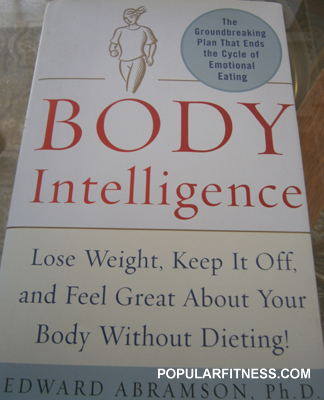
Here is a book excerpt that examines eating habits in a whole new perspective. It's focus is on smart ways of eating and to resist quick-fix diets by rethinking and examining your eating habits. Dr Edward Abramson uses a simple, smart and safe three step 'intelligent' approach that can show you how to eat intelligently, look at your body intelligently and use your body intelligently.
Book Excerpt
By Edward Abramson, Ph.D.

If you associate dieting with hunger or are just concerned that cutting back on your eating would leave you feeling unsatisfied, you shouldn’t worry because calories don’t count in satisfying your hunger. The amount of food you eat will determine whether you are hungry or satisfied regardless of the caloric content of the food that you’re eating. In other words, you can be more satisfied and lose weight by eating larger portions of less dense (fewer calories for the same size portion) foods instead of a smaller portion of more dense food. If you’ve found that dieting always leaves you feeling hungry, eating less dense foods can help you lose weight without this discomfort.
According to Dr. Barbara Rolls, Professor of Nutrition at Penn State and author of The Volumetrics Weight-Control Plan, for 100 calories you can have one-quarter cup of raisins, or for the same 100 calories you can have almost two cups of grapes. If you choose the grapes, you will be less hungry than if you choose the raisins. Since raisins are just dried grapes, the difference is water. When you drink water by itself it is unlikely to make you feel full, but when water is a significant part of the food you are consuming you will get full on fewer calories. Fruits, vegetables, stews, cooked grains, lean meats, fish, poultry, and soup have high water content, so they tend to be filling even though they are less dense. Likewise, foods high in fiber such as whole grains and beans are filling without adding a lot of calories. An additional benefit of high-fiber diets is a lower incidence of constipation and colon cancer. In contrast, high-fat foods, such as butter, full-fat salad dressings, and most desserts, are dense because fat has twice as many calories per serving as carbohydrates or proteins. Many dry foods like pretzels and crackers, even if they are low fat or fat free, are also dense. Five pretzel sticks have about twenty-five calories but won’t make a dent on your hunger. A whole tomato would be more filling and has the same number of calories.
One study demonstrated the value of low-density foods, especially when they are served at the beginning of a meal. Thirty-three women ate lunches consisting of a salad, followed twenty minutes later by a pasta main course. During the seven-week study, the density of the salad was varied and the amount of pasta consumed was unobtrusively measured. When the women ate a large portion of low-density salad, there was a 10 percent decrease in total calories consumed.
How hard would it be to plan to serve a large portion of a low-density salad or soup as a first course (The Volumetrics Weight-Control Plan has twelve soup recipes and twelve salad recipes) and wait a few minutes before starting the rest of the dinner? Remember, you don’t have to give up all high-density foods, just make sure that you have healthy servings of low-density food before you have smaller portions of the high-density foods.
One advantage of this approach is that, unlike diets that restrict the foods you can eat, it encourages you to add foods to your diet. Put fruit on your cereal, include apple slices in your chicken salad, place salsa on your chicken or fish, add vegetables to your marinara sauce, put eggplant in your lasagna, and add veggies to your shish kabob skewers. By adding low-density foods you will become full sooner and eat less of the high-density food. For a more detailed description of this approach that includes low-density recipes see Dr. Rolls’s book.
Reprinted from Body Intelligence: Lose Weight, Keep It Off, and Feel Great About Your Body Without Dieting! By Edward Abramson, Ph.D. Copyright © 2005 Edward Abramson, Ph.D. Published by McGraw-Hill; July 2005.
Author: Edward Abramson, Ph.D., is an internationally recognized expert on eating and weight disorders who lectures to professional and lay audiences around the world. He is a professor of psychology at California State University and a former director of the Eating Disorders Center at Chico Community Hospital. Dr. Abramson has appeared on "Hard Copy," "20/20," PBS, "Good Day LA," "Joan Rivers," and other TV and radio programs, and his work has been written about in Reader's Digest, Cosmopolitan, Good Housekeeping, Self, the New York Times, the Los Angeles Times, the Washington Post, and other major publications.
